Canada Is Already Connected to Los Cabos — and the New Routes Make Ownership Easier to Imagine
Los Cabos was not waiting for one new flight to become relevant to Canadian travelers. The April 2026 air-connectivity map already shows a meaningful Canada network. What the new winter routes do is widen that access, deepen seasonal frequency and make Los Cabos easier to use as a repeatable second-home destination.
-By Jhon Anderson
A new flight route is easy to treat as travel news.
An airline announces service. A tourism board celebrates more seats. Travelers notice a new nonstop option, and the story seems to belong mostly to vacation planning. For Los Cabos, however, air connectivity deserves a more serious reading because this is a destination where the distance between loving the place and owning a home here is often measured by how easy it is to return.
That distinction matters for Canadian buyers. A second home in Los Cabos is not only evaluated by architecture, view, community, title structure or price. It is also evaluated by repetition. Can the owner come often enough? Can family members visit without complicated routing? Can the home be used during winter, holidays, school breaks or longer seasonal stays? Can the trip feel practical rather than exceptional?
Air connectivity does not create desire by itself. It turns desire into access. That is why the Canada-to-Los Cabos story is stronger when it is not limited to the latest winter announcement. The April 2026 Los Cabos Tourism Board air-connectivity material already shows Canada as one of the destination’s most important international air markets. The map lists Canadian direct connections alongside Mexico, the United States, Germany and Panama, while the Canada table identifies nonstop service from Vancouver, Calgary, Toronto, Edmonton, Kelowna, Victoria, Winnipeg and Montreal through WestJet and Air Canada.
The new winter routes do not create the Canadian market from zero. They deepen it. That is the more useful interpretation for real estate. Los Cabos is already reachable for many Canadian travelers. The new routes from Toronto, Ottawa, Edmonton and Montreal make that reach broader, more flexible and more convincing for buyers who are thinking beyond one vacation.
For Baja Investments, this is not an airline story. It is a lifestyle-use story.
What the April 2026 Air-Connectivity Map Shows
The April 2026 Los Cabos air-connectivity report gives a useful baseline because it shows the destination’s existing direct-flight structure before the full winter 2026-2027 expansion becomes visible.
The country-level map identifies direct connectivity from five international markets: Mexico, the United States, Canada, Germany and Panama. It lists 16 Mexican connections, 32 U.S. connections, 11 Canadian connections and one connection each from Germany and Panama. That context matters because it places Canada in the destination’s primary North American air network, not as a marginal add-on.
The weekly-frequency table in the same report also shows how seasonal the Canadian market is. Canada appears with 39 weekly frequencies in April 2026, then 15 in May, 9 in June and 8 in both July and August.
| Country/Market | April 2026 | May 2026 | June 2026 | July 2026 | August 2026 |
|---|---|---|---|---|---|
| Mexico | 199 | 202 | 197 | 208 | 197 |
| United States | 332 | 272 | 288 | 292 | 206 |
| Canada | 39 | 15 | 9 | 8 | 8 |
| Germany | 1 | - | - | - | - |
| Panama | 3 | 3 | 3 | 3 | 3 |
| Total | 574 | 492 | 497 | 511 | 414 |
Source: Los Cabos Tourism Board, Air Connectivity, April 2026.
This table changes the way the article should be read. The story is not simply that Canada is adding new winter flights. The deeper story is that Los Cabos already has a seasonal Canadian pattern, with stronger service in the spring shoulder period shown in April and a reduced summer schedule from May through August. The winter additions matter because they build into a market that already exists but becomes far more practical when colder Canadian months begin.
For a traveler, that means more ways to reach the destination. For a homeowner, it means more ways to use the home.


Canada Was Already Part of the Los Cabos Network
The April 2026 report identifies two Canadian carriers serving Los Cabos directly during the period shown: WestJet and Air Canada.
WestJet appears with service from Vancouver, Calgary, Toronto, Edmonton, Kelowna, Victoria and Winnipeg. Air Canada appears with service from Toronto, Vancouver and Montreal. The frequencies vary by month, which reinforces the seasonal nature of the market.
| Canadian route shown in April 2026 material | Airline | Frequency pattern shown |
|---|---|---|
| Vancouver - Los Cabos | WestJet | 10 weekly in April, then 7 in May and 5 in June-August |
| Calgary - Los Cabos | WestJet | 8 weekly in April, then 6 in May, 3 in June and 2 in July-August |
| Toronto - Los Cabos | WestJet | 2 weekly in April, then 1 weekly May-August |
| Edmonton - Los Cabos | WestJet | 4 weekly in April and 1 in May |
| Kelowna - Los Cabos | WestJet | 2 weekly in April |
| Victoria - Los Cabos | WestJet | 1 weekly in April |
| Winnipeg - Los Cabos | WestJet | 1 weekly in April |
| Toronto - Los Cabos | Air Canada | 6 weekly in April |
| Vancouver - Los Cabos | Air Canada | 4 weekly in April |
| Montreal - Los Cabos | Air Canada | 1 weekly in April |
Source: Los Cabos Tourism Board, Air Connectivity, April 2026.
The important point is not that every route operates year-round. Many do not. The important point is that Canadian connectivity to Los Cabos is already distributed across several regions and carriers.
That distribution matters to buyers because ownership is rarely about one person taking one trip. A Toronto-based owner may care about their own schedule, but their adult children could live in Montreal or Ottawa. A Calgary buyer may already understand Los Cabos as a familiar winter destination, while family members in Edmonton or Vancouver may use different airlines. A Montreal buyer may want to know whether access is dependable enough for seasonal use or primarily useful for specific months.
A real-estate conversation should therefore begin with a more precise question than, “Are there flights from Canada?” The better question is:
Which Canadian cities will the owner, family and guests actually use to reach Los Cabos?
That question changes the property conversation.
What the New Canada Routes Add
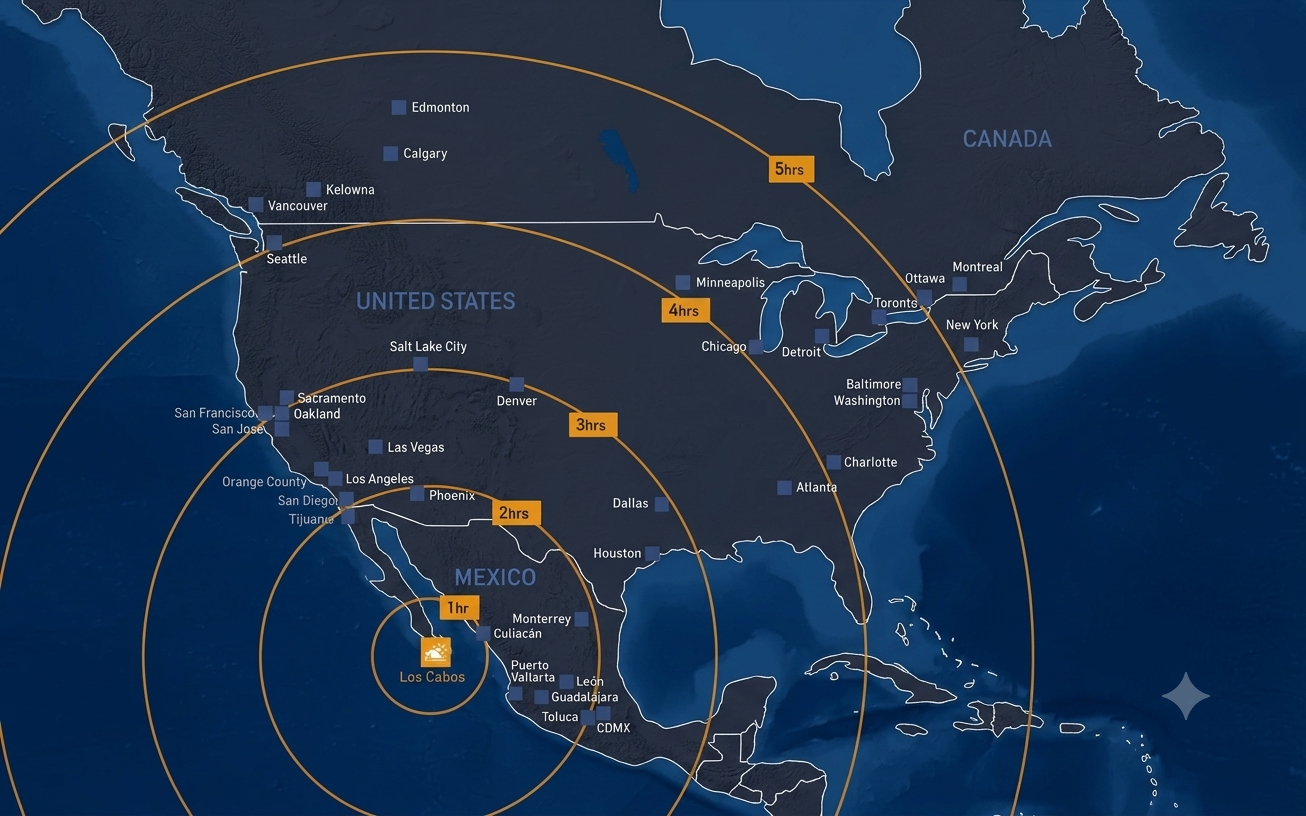
The new winter 2026-2027 routes add breadth and emotional certainty to an already meaningful network. Porter Airlines announced nonstop service to Los Cabos from Toronto, Ottawa and Edmonton for the winter 2026-2027 season. Its announcement lists Toronto-Pearson to Los Cabos beginning November 16, 2026 with three weekly flights, Edmonton to Los Cabos beginning November 16, 2026 with four weekly flights and Ottawa to Los Cabos beginning December 18, 2026 with two weekly flights at peak frequency. (Porter Airlines announcement).
Air Transat adds another important eastern Canadian layer. The airline announced Montreal-San Jose del Cabo service as part of its winter 2026-2027 program, with one weekly flight beginning December 10, 2026. (Air Transat announcement).
| New or expanded Canada - to - Los Cabos route | Airline | Start date announced | Announced frequency |
|---|---|---|---|
| Toronto - Los Cabos | Porter | November 16, 2026 | 3x weekly |
| Edmonton - Los Cabos | Porter | November 16, 2026 | 4x weekly |
| Ottawa - Los Cabos | Porter | December 18, 2026 | 2x weekly |
| Montreal - Los Cabos | Air Transat | December 10, 2026 | 1x weekly |
Those additions are meaningful because they touch different parts of Canada.
Toronto deepens an already important eastern gateway. Edmonton strengthens Alberta access beyond the Calgary pattern that many western Canadian travelers already know. Ottawa adds the national capital region more directly to the Los Cabos conversation. Montreal gains a new winter leisure route through Air Transat, adding another Quebec-based access point beyond the April Air Canada presence shown in the Los Cabos Tourism Board report.
The result is not simply more capacity. It is a wider ownership map.


Why Seasonality Is the Key Insight
The April 2026 material makes one thing clear: Canada-to-Los Cabos connectivity is highly seasonal. Canada shows 39 weekly frequencies in April, then drops to 15 in May, 9 in June and 8 in July and August. That pattern is not surprising. Canadian demand for warm-weather destinations naturally strengthens when winter approaches and softens during the summer months, when many Canadians stay closer to home or travel differently.
For a vacation traveler, seasonality is mostly a booking issue. For a property owner, it becomes a use-pattern issue.
A buyer planning to spend January, February and March in Los Cabos may find winter service far more important than July service. A family expecting holiday visits may care about December and March-break access. A remote worker may care about whether service is available across several months, not only during one peak week. A rental-conscious owner may need to understand how flight access aligns with high-demand travel periods.
This is why the April report is valuable even though the newer announcements focus on winter. It shows that air access is not static.
The practical buyer question is not only whether a city appears on a route map. It is whether the route operates during the months when the owner expects to use the home. That is a different standard.

Why Air Connectivity Matters to Real Estate
Real estate is usually presented through property characteristics: architecture, view, community, amenities, title structure, price and market performance.
All of those matter. But a second home is not experienced only when someone is inside the home. It is also experienced through the act of returning. The flights, airport experience, transfer time, guest logistics and ability to make repeat trips all become part of the ownership experience.
This is where air connectivity becomes relevant to Baja Investments. A Canadian buyer may want a Los Cabos home for several reasons:
● Winter escape;
● Extended seasonal residence;
● Remote-work base;
● Golf and wellness routine;
● Family gathering place;
● Future retirement option;
● Long-term personal asset;
● Personal use combined with selective rental.
Each use depends on access differently. A seasonal resident may care about consistent winter service. A family buyer may care about holiday and school-break timing. A buyer with adult children in different provinces may care about whether more than one Canadian city can reach Los Cabos directly. A remote worker may care about multi-month schedule reliability. A rental-minded owner may care about whether direct flights support guest demand during peak season.
Connectivity does not guarantee property appreciation. It does not guarantee rental income. It does not make every area of Los Cabos equally convenient.
What it does is make the destination more repeatable for the right buyer. That is a real ownership advantage, but it should be discussed with precision.

Canada Is Not One Buyer Profile
One of the strongest reasons to revise the article around the April 2026 material is that the file breaks Canada into actual cities and carriers.
That matters because Canada is not one buyer profile. A Vancouver buyer and a Montreal buyer do not experience Los Cabos the same way. A Calgary owner may see Baja California Sur as a familiar winter pattern. A Toronto buyer may compare Los Cabos with a much wider menu of sun destinations. An Edmonton buyer may respond strongly to improved nonstop service because winter access carries more emotional weight. An Ottawa buyer may not have had Los Cabos as naturally in the conversation until nonstop service made it easier to imagine.
The April 2026 report already shows Vancouver and Calgary as important western Canadian sources through WestJet, with Vancouver at 10 weekly frequencies in April and Calgary at 8. Air Canada also appears from Vancouver in April, while Toronto appears through both WestJet and Air Canada. Montreal appears through Air Canada in April, and Air Transat’s winter announcement adds a new Montreal layer for the 2026-2027 season.
Those details allow a more sophisticated buyer conversation. Instead of speaking broadly to “Canadian buyers,” Baja Investments can ask:
● Is the buyer coming from western Canada or eastern Canada?
● Does the family rely on one airport or several?
● Is the property intended for winter use, holiday use or year-round flexibility?
● Will friends and adult children visit from different cities?
● Is nonstop access essential, or is one connection acceptable?
● Which months matter most?
These questions are more useful than a generic statement that Los Cabos has more Canadian flights.


The Difference Between Vacation Access and Ownership Access
A vacation can tolerate inconvenience more easily than ownership. A traveler planning one annual trip may accept a connection, awkward timing or a return schedule that consumes most of the last day. The trip is exceptional, so the inconvenience can feel acceptable.
Ownership changes the standard. A second home becomes part of the household’s calendar. The owner begins to think in terms of frequency, flexibility and repeatability.
Can we go for ten days instead of three weeks? Can our adult children join us from another province? Can friends visit without needing a complicated itinerary? Can we use the home during the exact months we most want to escape the weather at home? Can we leave the property in professional hands and return easily when needed? Can the trip become part of life rather than a major annual event?
Direct flights do not answer every one of those questions, but they make more of them easier to answer. That is why the new winter routes matter most for buyers already close to the ownership decision. They may already love the weather, food, golf, beaches, boating and lifestyle. The route map helps determine whether those attractions become a repeatable pattern.
A beautiful property can still be the wrong fit if the travel pattern is too difficult. The reverse is also true. When the travel pattern works, the buyer can focus more clearly on the next question: which version of Los Cabos fits their life?


Connectivity Gets the Buyer Here. Lifestyle Determines Where They Belong.
Air access is only the beginning. Once a Canadian buyer reaches Los Cabos, the property decision becomes local and personal. San Jose del Cabo, Cabo San Lucas, the Tourist Corridor, Palmilla, Querencia, Cabo del Sol, Puerto Los Cabos, Chileno Bay and the East Cape do not offer the same daily rhythm.
A buyer from Vancouver may care about golf and seasonal ease. A buyer from Montreal may value professional property management and a clear winter use pattern. A Toronto buyer may compare Los Cabos with Florida, the Caribbean or other Mexican destinations. An Edmonton buyer may prioritize warmth, community and the ability to escape winter regularly.
The flight gets the buyer to SJD. The community determines how life feels after arrival. This is where a real-estate advisor becomes useful. The correct property search should not begin with every available listing. It should begin with how the buyer expects to use Los Cabos.
If the buyer will come for long winter stays, the questions may involve medical access, services, community, storage, pets and full-time comfort. If the buyer will come for shorter visits, management and lock-and-leave ownership may matter more. If family visits are central, bedroom configuration, airport convenience and guest access become important. If rental flexibility matters, property type, HOA rules, management and seasonality must be reviewed carefully.
Air connectivity creates possibility. Property selection determines whether that possibility becomes a good ownership experience.
How the April 2026 Data Changes the Buyer Conversation
The April 2026 Los Cabos Tourism Board material adds a useful layer because it shows the market before the future winter expansion.
That baseline changes three parts of the conversation. First, it shows Canada is already established in the Los Cabos air network. The April map lists 11 Canadian direct connections, and the route table identifies multiple Canadian cities through WestJet and Air Canada.
Second, it shows the Canadian market is seasonal. Frequencies drop materially after April in the months shown. That makes winter additions more meaningful because they strengthen access when Canadian lifestyle demand is most relevant.
Third, it shows why city-level analysis matters. Vancouver, Calgary, Toronto, Edmonton, Kelowna, Victoria, Winnipeg and Montreal are not interchangeable. They represent different travel patterns, buyer profiles and family logistics.
A buyer from Canada should therefore review air access with the same seriousness they give to HOA fees, community amenities or property management.
Not because flights are more important than the property. Because flights determine how often the property can become part of life.


What Canadian Buyers Should Ask Before Choosing a Property
A stronger route map should lead to better questions, not faster assumptions. Before choosing a community or property in Los Cabos, Canadian buyers should ask:
1. Which Canadian airport will we actually use most often?
2. Is the route seasonal or year-round?
3. Which months have the most practical schedules for our use pattern?
4. Are there direct alternatives if one airline changes frequency?
5. Can family and guests reach Los Cabos easily from their cities?
6. How much does flight timing affect our ability to use the home for short stays?
7. How long is the transfer from SJD to the property?
8. Do we prefer San Jose del Cabo, the Tourist Corridor, Cabo San Lucas or a more remote setting?
9. Will we need professional property management while we are in Canada?
10. If rental income matters, does the property perform because of its own merits or only because the destination is busy?
11. Are HOA, club or community rules aligned with guest use and rentals?
12. Does the property still make sense if an airline changes its seasonal schedule?
The last question matters most. Airlines adjust routes. Frequencies move with demand, aircraft, staffing, regulatory approvals and broader network strategy. A property should benefit from connectivity without depending entirely on one flight.
The best ownership decision uses air access as one layer of analysis. It does not confuse the route map with the whole investment thesis.
What This Does Not Mean
The revised data strengthens the article, but it also makes the limits clearer. The April 2026 connectivity map does not mean every Canadian city has year-round access. It does not mean the summer schedule is as strong as the winter schedule. It does not mean every route shown operates during every month. It does not guarantee that future announced routes will remain unchanged forever.
The new winter routes also do not mean every Canadian buyer will choose Los Cabos over every other sun destination.
They do not guarantee appreciation. They do not guarantee rental income. They do not make every property equally convenient.
They do not replace legal, tax, insurance, property-management, HOA, rental or community due diligence. The more accurate conclusion is this: Los Cabos already has meaningful Canadian air connectivity, and the new winter routes make that connectivity more compelling for buyers who want to use the destination repeatedly.
That is enough. It does not need to be overstated.


How Baja Investments Reads the Signal
At Baja Investments, the value of connectivity is not in treating every flight announcement as a sales argument.
The value is in understanding how access changes buyer behavior. A western Canadian buyer may already know Los Cabos and need help choosing between golf, beach, resort and residential-community lifestyles. A Toronto buyer may be deciding whether Los Cabos can compete with other warm-weather options. A Montreal buyer may be newly encouraged by seasonal direct service. An Ottawa buyer may begin considering the destination more seriously because the flight pattern feels easier. An Edmonton buyer may see the destination as more practical for escaping winter without routing through another city.
Those are different conversations. The route map helps shape the advisory process. It can influence whether the buyer should prioritize:
● A lock-and-leave residence;
● A full-service resort residence;
● A private-club community;
● A home closer to San Jose del Cabo;
● A Tourist Corridor property;
● A family-oriented layout;
● A property with rental flexibility;
● Professional property management;
● Storage and long-stay comfort.
The better question is not: Which properties are available? The better first question is:
How do you expect to use Los Cabos now that getting here is easier?
That is where a serious property search should begin.
Final Thoughts
The April 2026 air-connectivity material makes the Canada story more substantial. Los Cabos was already connected to Canada through a meaningful network of WestJet and Air Canada routes. The new winter 2026-2027 service from Porter and Air Transat adds another layer, especially for Toronto, Ottawa, Edmonton and Montreal.
For travelers, that means more choice. For tourism, it means stronger seasonal access from a broader Canadian geography. For homeowners and future buyers, it means Los Cabos becomes easier to repeat. That is the deeper point.
A second home is not only a place someone loves once. It is a place that must make sense again and again. The easier it is to arrive, return, host family and build a seasonal routine, the more believable ownership becomes.
Connectivity does not sell the home. It makes the life around the home easier to believe.
Let's Find the Right Community for You
Whether you're looking for an established neighborhood, a club-centered lifestyle, or a resort experience, we'll help you narrow down the options before you start touring homes.
Frequently Asked Questions
What does the April 2026 Los Cabos air-connectivity material show about Canada?
The April 2026 Los Cabos Tourism Board material shows Canada as one of the destination’s primary international air markets, with 11 Canadian direct connections listed on the map and 39 weekly Canadian frequencies in April 2026. The same report shows Canadian weekly frequencies decreasing to 15 in May, 9 in June and 8 in July and August.
Which Canadian airlines are shown in the April 2026 report?
The Canada section of the report shows WestJet and Air Canada. WestJet appears with Vancouver, Calgary, Toronto, Edmonton, Kelowna, Victoria and Winnipeg. Air Canada appears with Toronto, Vancouver and Montreal.
Which Canadian cities already had direct Los Cabos service in the April 2026 material?
The April 2026 material lists direct Canadian service involving Vancouver, Calgary, Toronto, Edmonton, Kelowna, Victoria, Winnipeg and Montreal. The exact frequency varies by airline and month.
What new Canada-to-Los Cabos routes were announced for winter 2026-2027?
Porter announced nonstop Los Cabos service from Toronto, Edmonton and Ottawa for winter 2026-2027. Air Transat announced Montreal-San Jose del Cabo service beginning December 10, 2026, with one weekly flight.
Why does the new winter service matter if Canada already had routes?
It matters because the new routes deepen an existing market. The April 2026 report shows Canada was already connected, but also seasonal. Winter routes add capacity and broaden access during the months when many Canadians are most interested in warm-weather travel and second-home use.
Are the new Canada routes year-round?
The newly announced Porter and Air Transat routes are winter-season services. Buyers and travelers should always confirm operating dates, flight days and frequency directly with the airline before making plans.
Why does air connectivity matter for real estate?
Air connectivity matters because ownership depends on repeat use. A home becomes more practical when owners, family and guests can reach the destination more easily during the months they actually intend to use it.
Do more flights mean Los Cabos property values will increase?
Not automatically. Additional air service can support destination demand and make ownership more practical, but property values depend on many factors: location, property quality, community, title structure, comparable sales, inventory, HOA costs, management, rental rules and broader market conditions.
Does better connectivity benefit every part of Los Cabos equally?
No. Flights bring buyers into Los Cabos, but the local lifestyle still differs by area. San Jose del Cabo, Cabo San Lucas, Palmilla, Puerto Los Cabos, Querencia, Cabo del Sol, the Tourist Corridor and East Cape all offer different daily experiences.
What should Canadian buyers verify before purchasing?
Canadian buyers should verify their primary departure airport, route seasonality, travel months, family and guest access, transfer time from SJD, property-management needs, HOA and rental rules, community fit and whether the property still makes sense if flight schedules change.
Is Canada one buyer profile for Los Cabos real estate?
No. A Vancouver buyer, Calgary buyer, Toronto buyer, Edmonton buyer, Ottawa buyer and Montreal buyer may have different travel patterns, family logistics, climate motivations and service expectations. The origin city should be part of the buyer profile.
How should Baja Investments use this information with buyers?
Baja Investments should use air connectivity as part of the lifestyle and ownership-use analysis. The best property shortlist should reflect where the buyer flies from, how often they expect to visit, who else will use the home and which Los Cabos community best fits that rhythm.
RELATED POSTS