The Place at Cabo: What to See—and Why It Matters to Cabo San Lucas
The Place at Cabo has turned part of a long-incomplete marina site into an evolving mix of dining, art, recreation and cultural experiences. Here is what visitors can experience today, what remains unfinished and why the project matters beyond being another place to shop or eat.
-By Jhon Anderson
The Cabo San Lucas marina has never had a problem attracting movement.
Boats leave before sunrise. Fishing crews return throughout the afternoon. Visitors move between the docks, restaurants, shops, tour desks and downtown streets, often deciding what to do next while they are already walking. By evening, the promenade becomes one of the most active parts of Los Cabos.
For years, however, one of the most visible sites along that movement gave people very little reason to stop. The unfinished structure near the marina had become familiar enough to disappear into the background. People passed it on the way to somewhere else, even though its location made it almost impossible to ignore. It occupied valuable waterfront space without fully participating in the life taking place around it.
That relationship has begun to change. Today, The Place at Cabo is an operating, though still evolving, marina-front destination with open-air restaurants, cafés, shops, galleries, art, family recreation and the recently opened Discovery Center. The complete vision has not been delivered, and the hotel remains part of a future phase, but enough is now functioning to make this part of the marina feel different. The practical question is whether The Place at Cabo is worth adding to a visit. The more interesting question is what happens when a place people once passed becomes somewhere they intentionally spend part of the day.
What Is The Place at Cabo?
The Place at Cabo is located in the Cabo San Lucas marina area, connected with the waterfront promenade and the central streets that carry visitors between boat activities, restaurants, shopping and downtown Cabo.
It is difficult to describe with a single familiar label because it is several things at once.
It is not simply a shopping center, although it contains retail spaces. It is not only a restaurant plaza, even though food and drinks are an important part of the current experience. It is not a museum, although Discovery Center has become one of its most distinctive attractions. It is also not yet the completed hotel destination suggested by some of the earliest announcements.
The most accurate way to understand it is as an evolving marina-front mixed-use destination operating in phases. Municipal reporting confirms that the commercial areas, common spaces, galleries and open-air restaurants were opened as part of the project’s second stage. The surrounding experience also includes pedestrian areas, art, landscaping, entertainment and businesses that continue to open over time.
This phased development explains why online descriptions can feel inconsistent. An article published during the initial rehabilitation may discuss features that were still planned. A later social post may focus on a restaurant, event or attraction that did not exist when the earlier article appeared. Some reports use the future hotel as the project’s primary identity, even though that is not the part visitors are currently using.
For someone planning a visit, the final master plan is less important than the operating experience. Enough is open today to make The Place part of a marina walk, a family outing, an early-evening plan or a visit centered on Discovery Center. It should be approached as a growing district rather than a completed resort with one fixed itinerary.
What Visitors Can Experience Today
The simplest way to understand The Place at Cabo is to walk through it without treating any single business as the entire reason for going.
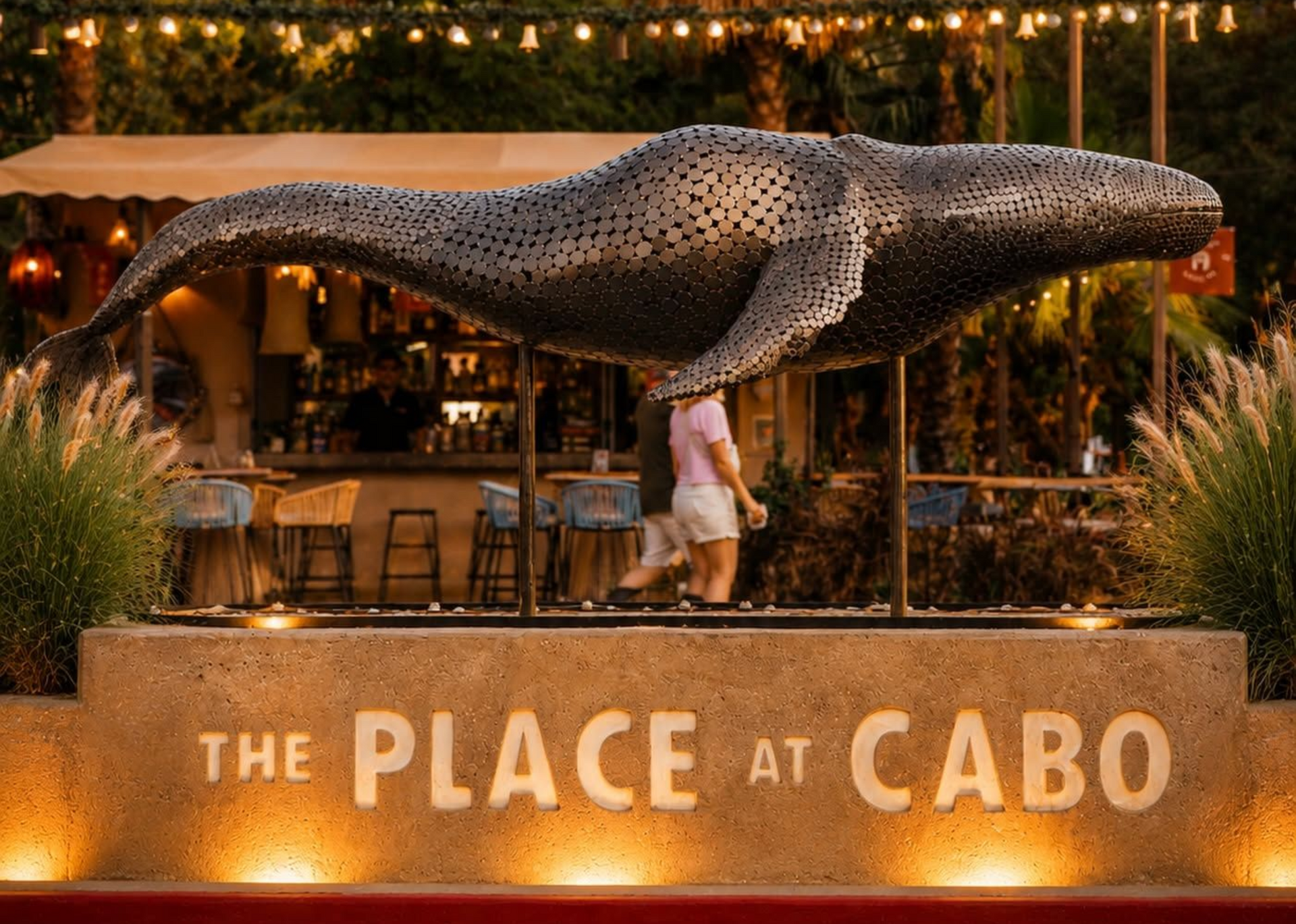
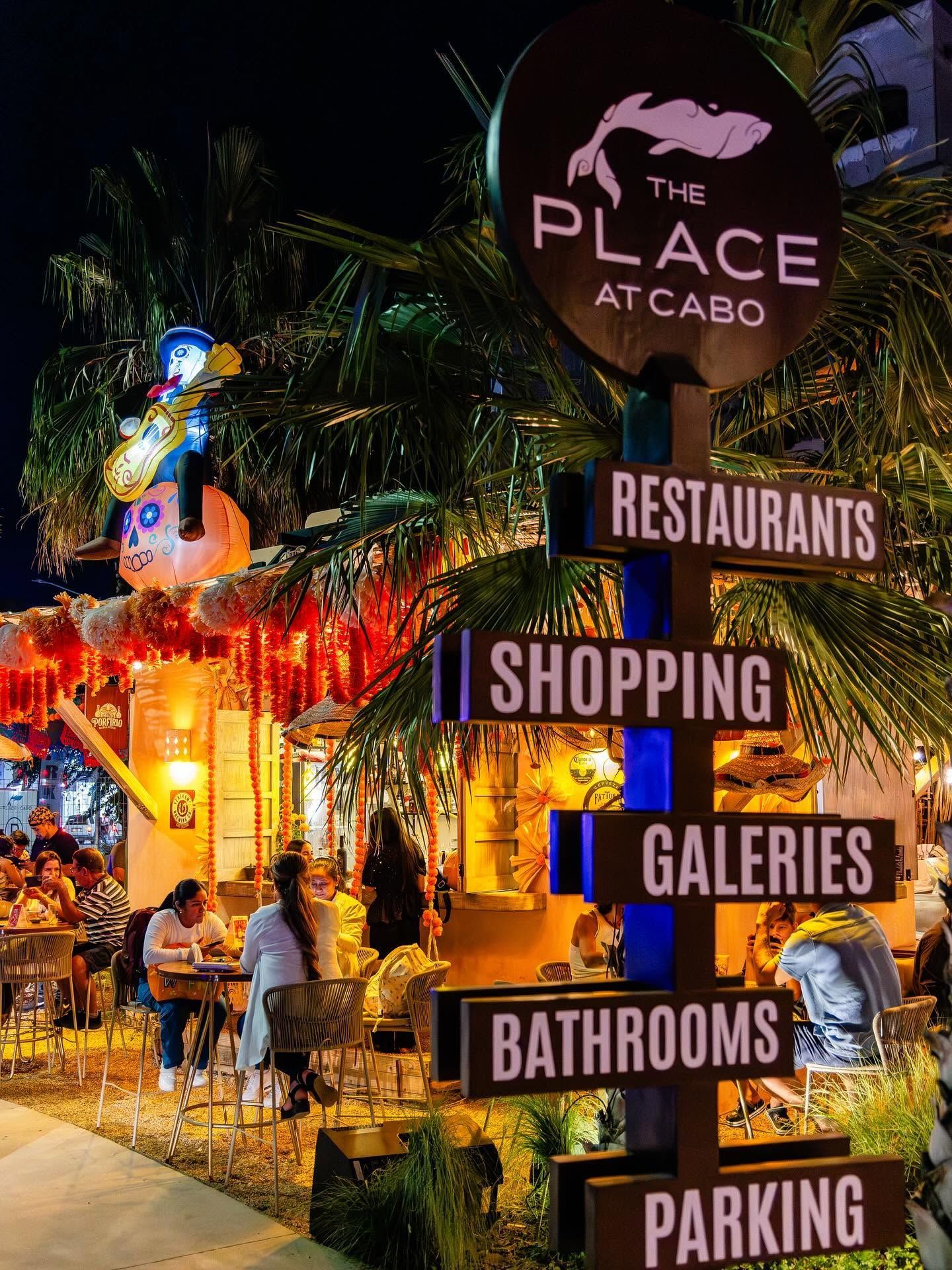
The experience is open-air and connected to the marina. Visitors can move between cafés, restaurants, bars, small shops, gallery spaces and public-facing art without entering a conventional enclosed mall. Trees, landscaping and shaded areas soften the transition from the active waterfront into a setting that feels more contained.
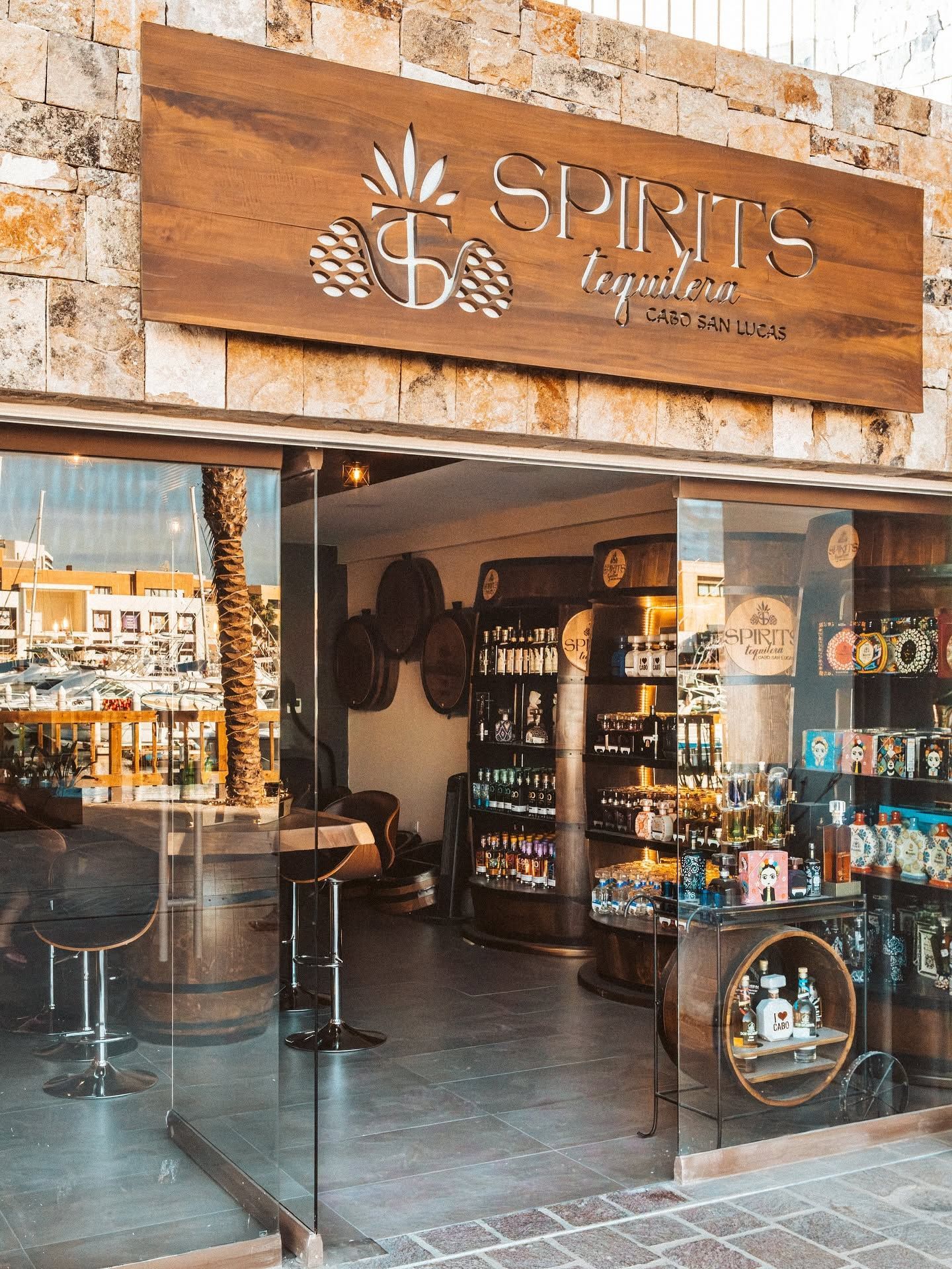
Dining is currently one of the strongest reasons to stop. The businesses will continue to evolve, so a permanent directory would become outdated quickly, but the mix includes casual food, coffee, drinks and concepts intended for a longer evening. Some visitors may arrive with a reservation in mind, while others will discover a place to eat after walking the marina.
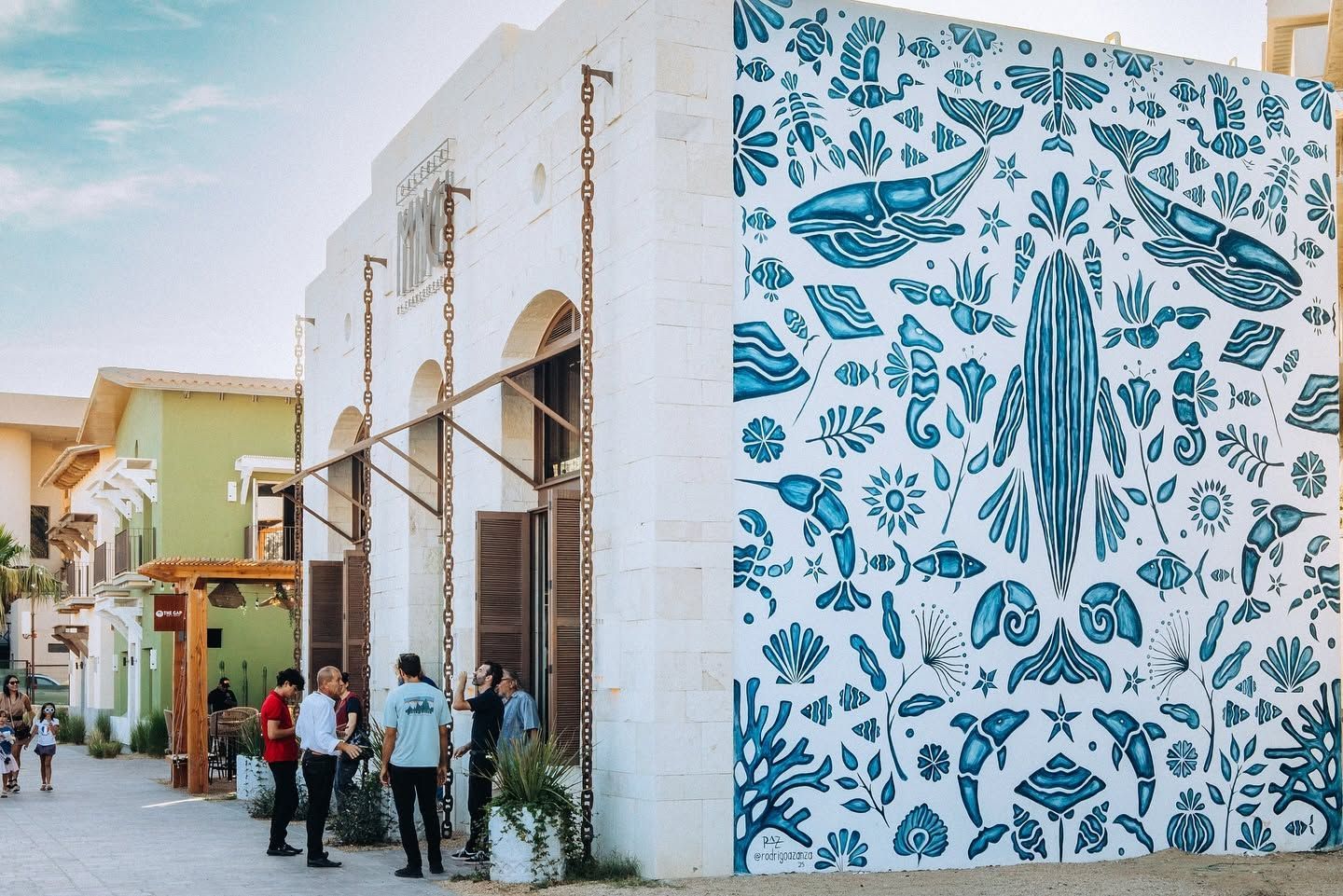
Art is not treated only as interior decoration. Sculptures, galleries, artist spaces and cultural events give the project a visual identity that feels connected to the pedestrian experience. Municipal reporting has highlighted sculptures with QR codes that allow visitors to learn more about the work, while local coverage has documented artists and craftspeople using the space to present their work.
The ferris wheel is the most immediately visible recreational element. It gives the area a recognizable landmark and adds a family-oriented activity that does not depend on dining, nightlife or a boat tour. Current programming has also included music, weekend entertainment and seasonal events, although schedules should always be checked through The Place at Cabo’s official channels before making a special trip. The Place works particularly well for several kinds of visitors.
A family can combine the ferris wheel and Discovery Center with food or a walk. A couple can include it in an evening around the marina. Repeat visitors may find it useful as an example of what has changed since their previous trip, while residents can use it more casually. It is not yet a self-contained full-day destination, and visitors should not expect every announced phase to be operating.
Its strength is flexibility: someone can arrive with one reason—coffee, dinner, the museum or the ferris wheel—and decide what comes next after getting there.
Discovery Center: A New Reason to Visit the Marina
The opening of Discovery Center Los Cabos in June 2026 gave The Place at Cabo something more significant than another commercial tenant.
Located within The Place at Cabo, the museum is dedicated to the natural richness, biodiversity and conservation of the Sea of Cortez. Municipal authorities described it as an interactive experience for both visitors and residents, while opening coverage documented four thematic rooms and an immersive 360-degree audiovisual environment.
It should not be confused with a traditional aquarium. The experience uses projection, sound, digital storytelling and controlled visual environments to create the sensation of entering the marine world without relying on conventional tanks or static displays. Its subject is closely connected to the destination: the whales, marine biodiversity and ocean environment that define much of the reason people travel to Los Cabos.
This matters because Cabo San Lucas has no shortage of experiences based on the water itself. Visitors can fish, sail, snorkel, dive, kayak, watch whales or take a boat toward the Arch. Discovery Center offers something different: an indoor interpretation of the environment people see outside.
That makes it useful for families, visitors looking for an indoor activity and travelers interested in the natural context behind the destination. It also changes the way The Place at Cabo can be understood. A collection of restaurants and shops may improve an area commercially. A museum introduces another kind of purpose. It gives someone a reason to arrive before deciding where to eat, and it connects the project with the identity of Baja California Sur rather than only the purchasing habits of its visitors.
Current schedules and admission details may change, so they should be confirmed through Discovery Center or The Place at Cabo before visiting.
From an Unfinished Structure to a Working Waterfront Destination
The history of the site is essential because The Place at Cabo is not simply another development built on an empty parcel outside town. The main structure remained incomplete for more than three decades, according to municipal reporting. Its unfinished condition was especially noticeable because it stood within one of the most commercially active and frequently visited parts of Cabo San Lucas.
The current rehabilitation effort began in 2022. Early phases focused not only on future hotel construction, but also on putting the surrounding area back into use. Municipal and local sources described galleries, boutiques, open-air restaurants, pedestrian walkways, landscaping and other improvements intended to reconnect the site with the marina.
This distinction matters because a destination can grow by moving outward—adding another resort, another community or another commercial center on previously undeveloped land—or by returning to a place that stopped functioning well and giving it a new role.
Mature destinations do not only expand outward. They also return to places they stopped using well. The most meaningful part of The Place at Cabo may therefore be the space between the unfinished building and the waterfront.
People do not need to wait for the complete hotel vision before using the restaurants, galleries, museum, art and pedestrian areas that already exist. The recovery is partial, but partial recovery can still change the daily experience of a site. That is a more credible way to evaluate the project than treating every future announcement as if it had already been delivered.
The hotel may eventually become the visual and commercial anchor of the full development. For now, the strongest evidence of progress is simpler: people can enter the area, spend time there and use it for purposes that were unavailable when the structure remained disconnected from the marina.
Why This Part of the Marina Matters
The Place at Cabo did not need to create an audience from nothing. The marina already carries a constant flow of people between fishing charters, sunset cruises, water taxis, restaurants, shops, nightlife, transportation and downtown streets. Visitors arriving from resorts often begin or end an activity there.
Cruise passengers walk through the area. Residents use the waterfront for business, dining and events. The challenge was not attracting movement, but converting movement into meaningful use.
That distinction explains why location is more important than the number of businesses in the project. A restaurant or gallery in an isolated area must convince someone to make a dedicated trip. A marina-front destination can become part of a plan already in progress. Someone may notice The Place after returning from a boat tour, combine Discovery Center with lunch or see the ferris wheel while walking before dinner. The project benefits from that flexibility because it sits between destinations rather than behind a single controlled entrance.
Its location also gives the project responsibility because anything built in such a visible part of the marina influences more than its own tenants. It affects the way visitors understand the waterfront, the quality of the pedestrian route and the relationship between downtown Cabo and the harbor. The project should therefore be judged partly by what happens outside the individual businesses.
Does the area feel comfortable enough to explore? Do people use it at different hours? Does the programming create reasons to return? Does the site remain visually and functionally connected to the marina around it? Those questions will matter more over time than the initial novelty of any single opening.

More Than Restaurants and Shops
The most successful tourism districts are not simply places with more things to buy. They are places where people enjoy spending time before deciding what to do next.
This is a subtle difference, but it changes how a destination feels. In a purely transactional commercial area, the visitor arrives for a particular business and leaves when the transaction is complete. In a more layered district, food, art, recreation, events and the physical environment overlap. A person can arrive without a complete plan and still find several ways to use the time.
The Place at Cabo is beginning to function in that second way. Dining may bring people into the area, but the art, ferris wheel, museum and cultural programming give them reasons to remain after the meal ends. The open-air circulation allows someone to see what else is happening rather than moving directly between a parking space and a single storefront.
This does not mean the project has already become a complete cultural district. Its identity is still developing, and some of the most ambitious future elements remain uncertain.
What interests me more is that the current experience no longer depends entirely on what may happen next. Discovery Center is open. The commercial and gallery areas are operating. Events have been held there. Families can use the recreational elements. Residents and visitors can walk through the site and decide whether it belongs in their regular experience of Cabo.
The Place is becoming less important as a project people hear about and more important as a place people actually use. That is the point at which a development begins influencing a destination.
What Is Open—and What Is Still Planned
The Place at Cabo has evolved quickly enough that articles from different years can all sound accurate while describing completely different versions of the project.
The clearest approach is to separate the current visitor experience from future or insufficiently confirmed plans.
| Visitors can experience now | Still planned, evolving or unconfirmed |
|---|---|
| Open-air restaurants, cafés and bars | Completion and final concept of the hotel |
| Retail and gallery spaces | Final hotel room count |
| Art, sculptures and cultural exhibitions | Reported hotel and entertainment concepts without final public confirmation |
| Discovery Center immersive museum | Passenger boat connection to Puerto Los Cabos |
| Ferris wheel and family recreation | Full scope and timing of later phases |
| Events and seasonal programming | Permanent tourism module unless its opening is confirmed |
| Marina-front pedestrian areas | Any unverified daily trolley schedule |
The unfinished hotel structure remains the most obvious future component.
Municipal announcements have previously referred to different hotel concepts and timelines, while later media coverage has introduced additional possibilities. Those reports should not be treated as part of the current visitor experience until the operator, brand, scope and opening have been confirmed.
The same caution applies to transportation concepts announced during earlier phases. A proposed boat connection, trolley or visitor-information module may eventually add value, but it should not shape a visitor’s plan before current operation is verified.
This is not a criticism of phased development. It is a distinction between a master plan and a usable destination.
The Place at Cabo already offers a legitimate experience. It does not need speculative features to justify the parts that are open.
What The Place Reveals About Cabo San Lucas
Cabo San Lucas is often described through a short list of familiar attractions.
The Arch. Medano Beach. The marina. Sportfishing. Boat tours. Restaurants. Nightlife. Those experiences remain central to the destination, but they no longer describe everything happening around the waterfront.
The Place at Cabo adds a different combination: art, family recreation, an immersive museum, open-air dining and events inside an area that previously contributed very little to the experience around it. That combination suggests a broader evolution: tourism districts mature when they create different reasons to visit at different hours and for different types of people. A visitor traveling with children may not want the same evening as a group focused on nightlife. A returning traveler may want something beyond another boat tour. A resident may want to use the marina without feeling that every activity was designed exclusively for a first-time tourist.
The Place does not solve every limitation of downtown Cabo, and it should not be used as proof that the entire city has become more walkable, cultural or family-oriented. It is one example, but examples matter because they show what the destination is beginning to make room for.
Cabo San Lucas can remain energetic, commercial and tourism-driven while adding experiences that are educational, artistic and easier to use without a tightly scheduled itinerary. The city does not need to become quieter to become more varied, and that variety gives repeat visitors another reason to return while giving residents more ways to use a part of town often defined by tourism.
What It Means for People Who Live Here
A better visitor experience does not automatically create a better place to live, although the two can overlap. Restaurants, museums, galleries, events, pedestrian spaces and family activities do not disappear when vacationers return home. Residents can use the same places more casually, at different hours and with different expectations.
The Place at Cabo is particularly relevant to people who enjoy the active side of Cabo San Lucas. Living near downtown or the marina can mean easier access to dining, boating, nightlife, events and everyday services. It can also mean more visitor traffic, more noise and a closer relationship with the tourism economy.
That rhythm is different from living in Palmilla, a gated golf community or a quieter part of San José del Cabo. Neither lifestyle is automatically better. Someone who values activity, spontaneity and the ability to walk toward restaurants or the marina may find central Cabo attractive. Someone prioritizing privacy, separation from tourism and a more residential routine may prefer another part of Los Cabos.
This is why understanding a destination should come before comparing properties. A home is not experienced only through its floor plan, view or list of amenities. It is also experienced through the kind of day available outside its door.
The Place at Cabo adds more substance to the downtown and marina side of that comparison. It does not turn Cabo San Lucas into a different city, but it gives the area another cultural and recreational layer. For buyers still deciding which part of Los Cabos fits them, comparing this active marina lifestyle with the top residential areas of San José del Cabo is more useful than comparing property prices alone.
Once the lifestyle is clear, the practical process of
buying property in Los Cabos as a foreigner becomes a much better-informed conversation.
Is The Place at Cabo Worth Visiting?
The Place at Cabo is worth visiting, with the right expectations, for travelers who are already spending time around the marina, repeat visitors interested in what is new, families looking for a combination of recreation and an indoor cultural activity, and anyone planning to visit Discovery Center.
It works especially well as part of a larger plan. A visitor might combine the museum with lunch, include the ferris wheel in an evening walk or arrive for dinner and explore the galleries and public art before leaving. The project is flexible enough to support a short stop or several hours, depending on what is operating that day. It is less suitable for someone expecting a completed destination resort, a finished hotel or a full day of attractions contained within one complex.
The Place remains in progress, and that incompleteness is important, but it is no longer the entire story. For decades, this part of the marina was defined by a structure that people noticed and continued walking past. Today, the project’s success can be measured in a simpler way: people have reasons to enter, look around and remain.
The Place at Cabo may ultimately be judged less by the number of phases announced than by whether people continue finding reasons to use the spaces already open.
Find Your Place in Cabo San Lucas
The Place at Cabo is just one example of how downtown continues to evolve. Discover homes that let you enjoy the marina, restaurants, beaches, and everything Cabo San Lucas has to offer.
FFrequently Asked Questions About The Place at Cabo
Is The Place at Cabo open?
Yes. The commercial areas, open-air restaurants, galleries, art spaces, recreational elements and Discovery Center are operating. The larger project is still developing in phases, and the hotel is not part of the current visitor experience.
Where is The Place at Cabo located?
The Place at Cabo is located in the Cabo San Lucas marina area, connected with the waterfront promenade and central Cabo San Lucas. It sits near the routes visitors use for boat tours, dining, shopping and downtown activities.
What can visitors do at The Place at Cabo?
Visitors can explore open-air restaurants and cafés, shops, galleries, sculptures and family recreation. The ferris wheel is one of the most visible attractions, and Discovery Center provides an immersive indoor experience focused on the Sea of Cortez. Events and entertainment are also scheduled periodically.
Is Discovery Center Los Cabos open?
Yes. Discovery Center opened in June 2026 at The Place at Cabo. It uses immersive digital environments, sound and visual storytelling to present the biodiversity and conservation of the Sea of Cortez. Visitors should verify current hours and admission details before arriving.
Is there a ferris wheel at The Place at Cabo?
Yes. The ferris wheel is part of the current recreational experience and is visible from the marina area. Operating hours can vary, so travelers making a special trip for the attraction should confirm the latest schedule through The Place at Cabo’s official channels.
Is The Place at Cabo good for families?
It can be. Discovery Center, the ferris wheel, pedestrian areas and family-oriented programming create options beyond restaurants and nightlife. Suitability will depend on the child’s age, the weather and the attractions operating that day.
Are there restaurants and bars?
Yes. The Place at Cabo includes restaurants, cafés and bars in an open-air environment. Because businesses and operating hours may change as the project develops, it is better to check the current directory or official social channels than rely on an older permanent list.
What are The Place at Cabo’s hours?
There is no single dependable schedule for the entire complex because restaurants, retail spaces, Discovery Center and recreational attractions can operate at different times. Check the specific business or attraction before visiting.
Is the hotel at The Place at Cabo open?
No. The unfinished hotel structure remains part of a future phase. Visitors should not confuse the operating commercial, cultural and recreational areas with a completed hotel opening.
Is a Universal hotel or theater confirmed?
Various future entertainment and hotel concepts have been reported, but they should not be treated as confirmed operating components without a formal announcement from the relevant brand and project operator. They are not necessary to understand what visitors can experience today.
Is there parking at The Place at Cabo?
Parking was included in the project’s initial operating plans, but current availability, access and fees may change. Visitors driving specifically to The Place should verify the latest parking information or allow time to use another downtown or marina parking option.
Is The Place at Cabo mostly for tourists?
The location and businesses are strongly connected to the visitor economy, but local residents also use the restaurants, events, galleries, museum and family activities. The Place is best understood as a tourism-oriented space that can also become part of everyday local life.
How much time should I spend there?
A brief walk may take less than an hour, while a visit that includes Discovery Center, a meal and the ferris wheel can take several hours. The Place works best when incorporated into a marina afternoon or evening rather than treated as a rigid, self-contained itinerary.
Is The Place at Cabo worth visiting at night?
The open-air restaurants, lighting, ferris wheel and periodic entertainment can make evening one of the most appealing times to visit. Event and attraction schedules vary, so check current programming before planning an evening around a specific activity.
RELATED POSTS